
GTA 5’s Trevor Flipped the Bird at Rockstar's Haters
Ever since GTA 3’s protagonist (a stoic murder proxy allegedly named Claude) melted our hearts, every one of Rockstar’s rich and varied litany of leading men has reached iconic status. But there’s one that stands out as their most brilliant, subversive best.
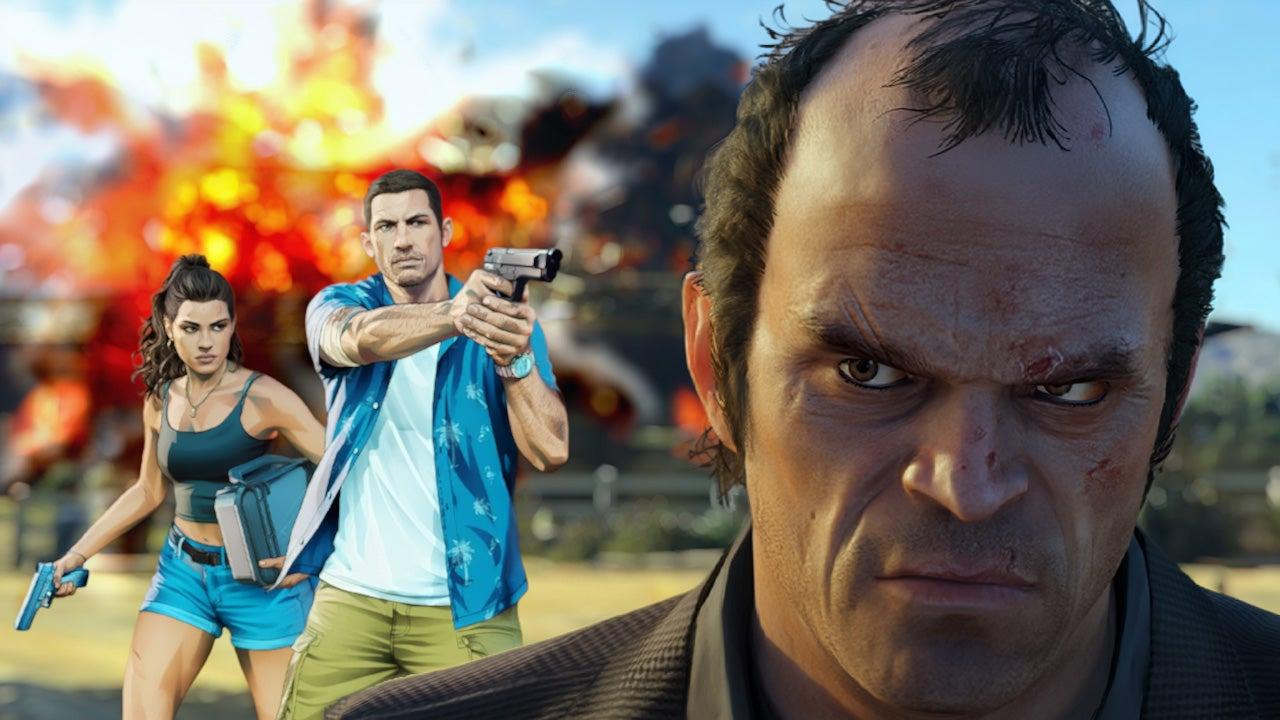
Rockstar’s biggest triumph, though, is that their other greatest character isn’t subversive at all. In fact, he is Mr. GTA , absolutely everything you and your mum might associate with the series embodied in one gloriously nasty psychopath.
Trevor was created in part to solve the conundrum of what media wanks in the late '00s liked to call "Ludonarrative Dissonance", a phenomenon in games like this where the actions of the player in the open world are at odds with the motivations of the character.
It’s something that reached its most absurd extent in GTA 4, where you had a character whose Tinder profile would read “Sad About War” waging his own endless conflict against the LCPD, pigeons, bystanders, hot dog vendors, and anyone else. Depending on who was at the controls, of course. Essentially there are two Niko Bellics , two CJs , two Arthur Morgans : the character given voice by writers, and the avatar that exists only as a conduit for player agency. Usually to commit atrocities in the name of escapism.
GTA 5’s Trevor Philips is well understood to represent that sort of player. But he isn’t just a conduit, he almost is The Player made manifest in that universe. An ambassador for the user. A composite of playing styles given personality and an overactive sex drive, designed to evoke the way your wee brother plays GTA: that is, causing mayhem for the sake of it and achieving very little in the process. And imagining what happens when that specific GTA guy is given narrative agency.
His infamous introduction is as freeing as it is shocking: he enters the story of GTA 5 at perhaps his most vile. Motivated only by base desires. Brutally murdering a beloved former protagonist for merely speaking out of turn. At this point, GTA fans had spent dozens of hours playing as Johnny Klebitz in The Lost and Damned, a harrowing story of gangland betrayal that ends on a hopeful note, with Johnny cutting ties with the bad influences in his life and pledging to go straight. By the time we meet him again in GTA 5, he’s a sickly looking meth addict who has fallen right back into the world he’d managed to escape from.
But we barely got any time to think about that, because after swiftly kicking him to death, we as Trevor Philips had work to get on with. It’s a bold move to bring in a new character by diminishing an established one. It certainly can work, but it usually means the incoming character starts with an uphill battle to get the audience on their side.
You’d be forgiven for thinking that Trevor isn’t supposed to be liked at all. Some readings of GTA 5 call him the true villain of the piece: and it’s not hard to see why. On paper there’s nothing especially likeable about him. He doesn’t stand for anything, is a hateful jerk, and as an idea he’s about as complex as the wee ship in Asteroids. The challenge, then, is how to make such a character compelling without betraying the deliberate lack of complexity at his core. Surely nothing would ruin Trevor more than that wretched cowardly device we call nuance. I know writers who use subtext, etc. Everything Trevor does has to be in service of his immediate wants or his personal enrichment.
But complexity doesn’t have to mean riddled with contradictions. Trevor has a moral code of sorts, he values loyalty, not just to himself but as a general virtue, which is what fuels his deep-seated rage at Michael during his first story act. But, despite this delineating betrayal, he displays an unwavering allegiance to Michael’s young family, caring for his children to whom he considers himself an uncle.
As his fraught backstory becomes fleshed out in drips and drabs over the course of the game, the writers are keen to give any tragic revelations some ballast so they don’t ever become excuses or justifications for his behaviour. On the one hand, we find out that he has a history of childhood abuse and abandonment. On the other, it’s heavily implied that he’s an infamous serial strangler and a cannibal. We know that he’s a gifted aviator, but that his career as a fighter pilot is cut short in the eighties when he fails a psyche evaluation. It’s sort of hard to take Trevor’s side over the Canadian military in that instance.
Canadian. Yes, no doubt inspired by his actor Steven Ogg hailing from up north, Trevor who is about as antithetical from the concept of politeness as any human being can be, is from Canada. That Trevor is one of the core American archetypes – a troubled forces veteran who has been utterly failed by the system – and yet isn’t even American might be one of the best jokes in the entire game.
The player is rarely asked to feel sorry for Trevor. Even at his lowest ebb, where we see him briefly start to build a relationship with his estranged mother only for her to abandon him again, triggering a regressive outburst of psychological anguish, we’re forcibly transferred to a different character while the consequences of that are played out off-screen.
The great parlour trick that Rockstar pulls off with Trevor is to give him dimensions and layers enough to rival that of Niko Bellic, but without falling into the same trap of Ludonarrative Dissonance. In fact, it achieves a state of ludonarrative harmony : one not seen since Vice City avoided all this nonsense by having you play as a coke fiend. But unlike Tommy Vercetti’s inspiration Scarface, Rockstar becomes truly untouchable in the process: creatively and morally untethered, exiting the media’s field of influence on a rocket ship powered by cash.
Source: Read the full article on IGN →