

"I think one of the reasons GTA was so well received was the amount of detail," reflects an original dev: "No one ever said no, or that something couldn't be done"
Copy link Facebook X Pinterest Flipboard Email Share this article 0 Join the conversation Follow us Add us as a preferred source on Google Newsletter Subscribe to our newsletter We currently find ourselves on the cusp of a brand new appendage to the Grand Theft Auto series. A release that will find fans returning to a very special place. Liberty City is a virtual homage to the bustling streets of New York and is unarguably the most infamous metropolis of any videogame to date. It's become as iconic to the series as the freedom, the carjacking and the infectious wrongdoing, and for many it marks the very first time they ever came to experience an 'open world' environment in a videogame.
The person responsible for designing and building Liberty City was Paul Farley. Ironically, his background wasn't in programming or videogames although he admits to being brought up on a staple diet of ZX81 and Spectrum but in architecture. Working for a small architecture firm after finishing the first year of his degree, Farley came to realise that a career in construction really wasn't for him, and decided to answer a job advertisement, posted by DMA, who at that time were looking to expand and hire a new team of level designers.
Can't wait for the new Grand Theft Auto? Join our Countdown to GTA 6 hub for all the latest updates, features, and retrospectives on the series' legendary history.
"I had no real idea what a level designer was but I'd always loved videogames. The interview process was spread over two days and I remember thinking at the time that it was one of the most challenging things I'd ever been faced with," admits Farley. "On the second day I was sat down in front of a puzzle game that they had in development and was tasked to build a fully working puzzle in 30 minutes. I was left alone to sweat it out. I don't think the puzzle even worked. But they must have seen something, because I got the job."
At the time that Farley joined DMA, the company would be divided while it worked on two very different projects: Body Harvest, a planned launch title for the Nintendo 64, and another, slightly less highbrow game for the PC. Body Harvest was DMA's flagship project, and Farley remembers vividly the interest which the game generated among the new recruits.
"There were four level designers that started at the same time as me. I remember being shown around on that first day. We were going to be split up based on the needs of two new projects that had just been started and we all wanted to work on Body Harvest. It was just so damn sexy, all those 3D graphics, the N64 development kits and Silicon Graphics workstations sat around it was like mission control at NASA," explains Farley. "Anyway, as it worked out, neither of us got to work on the Body Harvest project, our skills would be put to use on a rather drab-looking top-down racer which at that point had the working title 'Race 'N' Chase'."
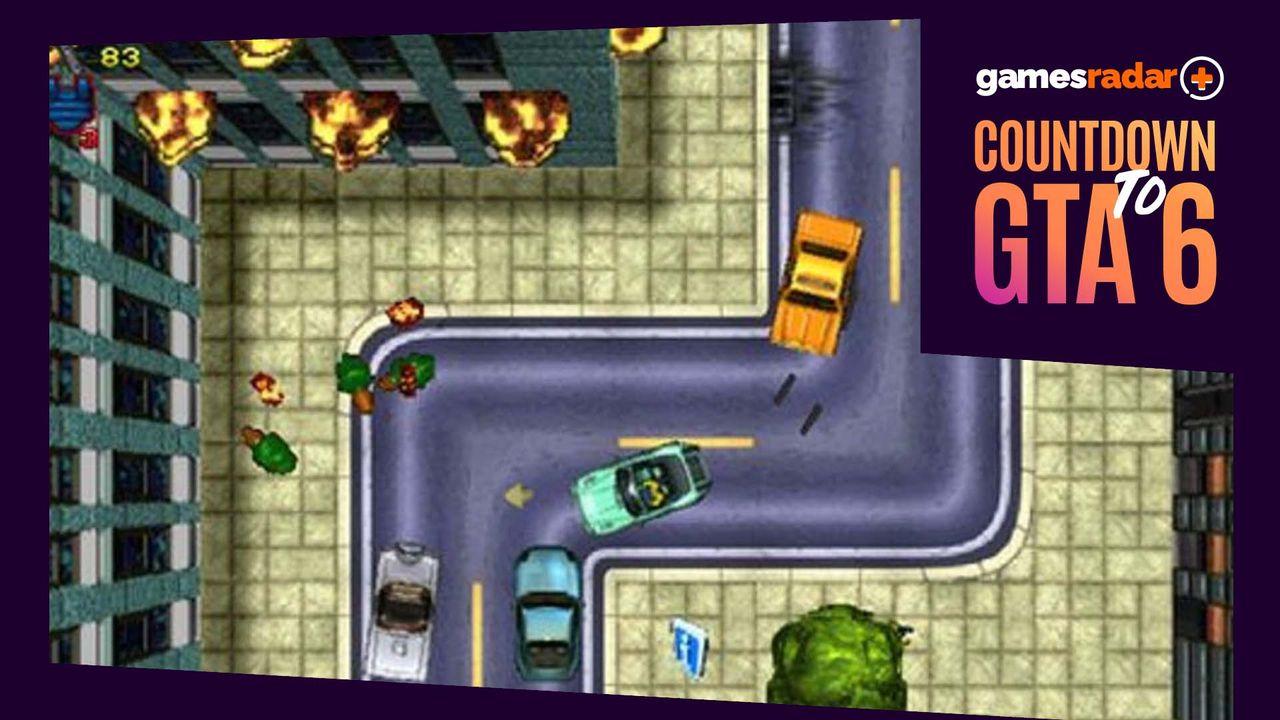
'Race 'N' Chase' is where the genesis of Grand Theft Auto can be found. Mike Dailly, who at the time was lead programmer at DMA, had been working on a code that would produce isometric cityscapes. Viewed from an aerial camera that the player could intuitively manipulate, and coined Rotation, this engine would become the first Grand Theft Auto prototype.
However, fate would intervene when Bullfrog released Syndicate Wars, and after spotting its glum Orwellian Blade Runner-style skyscrapers, Dailly knew that his engine looked just too similar and decided to rework it. Oddly, it was after seeing the Sega Saturn game Clockwork Knight that Dailly considered switching the engine to a side-on perspective, but after a conversation with a colleague, he decided to set his sights a little higher.
Weekly digests, tales from the communities you love, and more
"I was speaking to John Whyte (who at the time was working on Body Harvest for the N64), and he'd been trying to get an overhead racing game past Dave Jones [DMA's founder] for a while. Dave, however, wasn't interested," explains Dailly.
"It then occurred to me that although I had a side-on engine, all I needed to do was add a floor and it would easily become an overhead engine. I set about using the previous GTA prototype as a base. Using cubes, I built an array of perspective points then, with a simple 3D array, attached faces to each active cube. I removed interior faces (since they couldn't be seen) and rendered the resulting city. Looking at it, they decided to restart Race 'N' Chase, but using the new engine since it would allow far more freedom and a true perspective. GTA was a real team effort, and had input from every team member, this was how it all started. It shows how important true R&D is, without it several DMA games would have never been started."
The parallax movement of the buildings, and the way in which the camera would lock on to your car and pull away the faster it travelled led to the possibility of creating an overhead police chase/action game. And so Dailly's overhead city engine was used as the backdrop.
When Farley was assigned to the Race 'N' Chase project he was keen to utilise his knowledge of architecture, and set about plotting each map on a piece of paper. This was how all of the cities inside Grand Theft Auto would begin as 2D maps of roads, sidewalks and buildings and once complete, using a mapediting tool, they would be translated into the vibrant and detailed 3D cities that we can see in the game.
It's a well-known fact that the three game maps Liberty City, Vice City and San Andreas were based on the cities of New York, Miami and San Francisco respectively. They also contained subtle nods to well-known areas of each city. For example, Liberty City's sections included Park (Central Park), New Guernsey (New Jersey) and Brocklyn (Brooklyn).
Map at it again
This feature originally appeared in Retro Gamer magazine #50, in the run-up to GTA 4's release. For more in-depth features and interviews on classic games delivered to your door or digital device, subscribe to Retro Gamer or buy an issue !
The first hurdle that the team had to overcome was getting to grips with the mapping tools. None of the team had any experience of using map editors, and while the tool chain at DMA was very well instigated, it would take a lot of time for the new team to learn all the different techniques that were available. Also, the team would find that they had no way of viewing the city in three dimensions until they ran it in the actual game.
"Personally, it was a pretty smooth transition to go from designing individual buildings to then designing a whole city. The design criterion is different. For the game, you were designing form and function to support gameplay, rather than in real life where you design a building to support an activity or movement. But the actual process was remarkably similar," explains Farley.
Given the theme and subject of Grand Theft Auto, you'd expect the team to be governed by a strict list of rules and the missions to be pencilled in before development began to help ensure its safe passage through the censors. But Farley confesses that working on GTA was quite a liberating experience.
"The working brief was non-existent other than some guidance from the head of art," recalls Farley. "Most of us had no experience at all and were making it up as we went along. I think that spirit of adventure and freedom is conveyed in the final game and went a long way to helping to define many of the design decisions. In terms of the look and feel of the city the level designers worked closely with the artists to create locations and a style for each of the cities. Once a set of tiles had been completed it was then the level designer's job to use them like Lego blocks to create the city. I think the art team was always quite amazed and sometimes horrified at the manner in which we creatively used their tiles to create new textures and forms."
Grand Theft Auto is a brilliant juxtaposition of a dour and depressing world, but painted with vibrancy and colour. It certainly feels the most chipper of the series, as it holds this brilliant sense of irreverence and fun throughout its missions. The way your character would comically hop over the bonnets of cars and pepper those poor Hare Krishnas all over the road as they tried to cross in front of you was just so strangely enjoyable. The realism and popular culture references of the later games have all but drowned out those jubilant audience cheers and squeaky voices that pumped from those blue phone boxes.
"When we started the game it used 8-bit graphics and the palette was much darker and more realistic than the final release. At this stage PC technology was moving at a really fast rate and with the game taking a while to finish anyway, the decision was made to switch to 32-bit graphics, giving us a much wider palette. I think the whole art department at DMA spent the next two weeks redrawing the game tiles and sprites. The result was a much brighter and more colourful game, which in the long run helped reduce some of the impact of the adult nature of the game," explains Farley.
Liberty City took four to five months to design and build, and the mission design and scripting would take a further six months. Over the course of its development the core team would change, other departments would be drafted in to assist, and at one point DMA's entire art department were put to work on the game.
The original Race 'N' Chase design was the one that DMA pitched to BMG. And it wasn't until after the publisher was on board that the name would later be changed to Grand Theft Auto. As the game presented the player with so much choice, checking for bugs and glitches proved to be very difficult and the game's development would stretch from 15 to 30 months. Its 'open world' environment lacked constraints, allowing for plenty of different routes and ways to complete its missions. And each needed to be played through to its completion because, as was the nature of the engine, every new element that was added could potentially affect another.
"It's kind of hard to overrun when you don't have a schedule, but we were aware that GTA, like all the other projects DMA had then, was taking too long. I think the publisher was more concerned than us though," Farley says. "Most team members worked extra hours because we were all so excited by what we were creating. There was this energy and feeling about the place that what we were working on was really special and that it really mattered. At DMA there was this mentality that a game wasn't finished until they were happy with it. Very few developers are ever in that position so it was refreshing, and ultimately led to some great innovative games. It also led to some turkeys that should have been canned after six months but weren't."
Grand Theft Auto debuted on the PC in 1997. Initially developed in DOS, it would later be ported to Windows, PlayStation and it even found an admittedly poor, but technically impressive, Game Boy Color conversion. There were also rumoured to be Nintendo 64 and Saturn conversions in the works, which would have been refined ports of the PlayStation port, but sadly they never found a release.
What really helped to set Grand Theft Auto apart from other games of the time was its sense of freedom (hence the name Liberty City), as fun could be found by simply deviating from the missions and exploring the game's colourful environments.
On to new roads
The game was well received by many in the gaming press, garnering rave reviews and even a Gold Award in PC Format. However, the tabloids, most notably the Daily Mail, would criticise Grand Theft Auto for its violent themes, which many people felt it was trying to glamorise.
"I think one of the reasons GTA was so well received was the amount of detail it showed the love and attention that had been heaped on the game by the people making it," says Farley.